Here are the keywords to understand material given by our teacher Gabriel, the PDF "practice ANSYS- simulation 1"
Engineering Data
Noun
Any information that collectively becomes the knowledge on which an engineer can design and build the proposed end-product. This information comes as drawings, manufacturer's specifications, and standards.
Example: Engineering data works in conjunction with data science teams, improving data transparency and enabling companies to make more confident business decisions.
es: Datos de Ingeniería
heat sink
Noun
A heatsink is an instrument used to lower the temperature of some electronic components. Its operation is based on the zero law of thermodynamics, transferring the heat from the hot part that you want to dissipate into the air.
Example: En los dispositivos electrónicos se suelen usar los disipadores de calorpara evitar un aumento de la temperatura en algunos componentes.
es: disipador de calor
Isotropic thermal conductivity
Noun
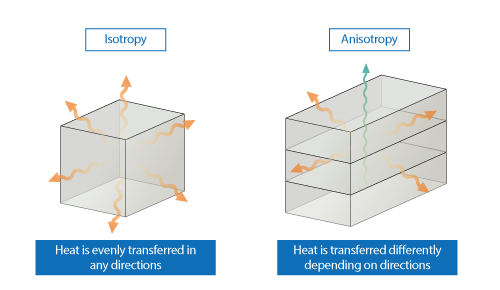
Materials are considered to be isotropic if the properties are not dependent on the direction. This property is required for a transient heat transfer analysis. Thermal conductivity: The thermal conductivity of a material is a measure of the ability of the material to conduct heat.
Example: Isotropic thermal conductivity specifies that the Heat Flux J, depends linearly and isotropically on the gradient of the Temperature Field T.
es: Conductividad térmica isotrópica
Mesh
Noun
Finite Element Analysis (FEA) provides a reliable numerical technique for analyzing engineering designs. The process starts with the creation of a geometric model. Then, the program subdivides the model into small pieces of simple shapes called elements connected at common points called nodes. The process of subdividing the model into small pieces is called meshing.
Example: Meshing is a crucial step in design analysis. The software automatically creates a mixed mesh of solid, shell and beam elements. The solid mesh is appropriate for bulky or complex 3D models. Beam elements are suitable for structural members.
es: Malla
Steady-State Thermal analysis
Noun
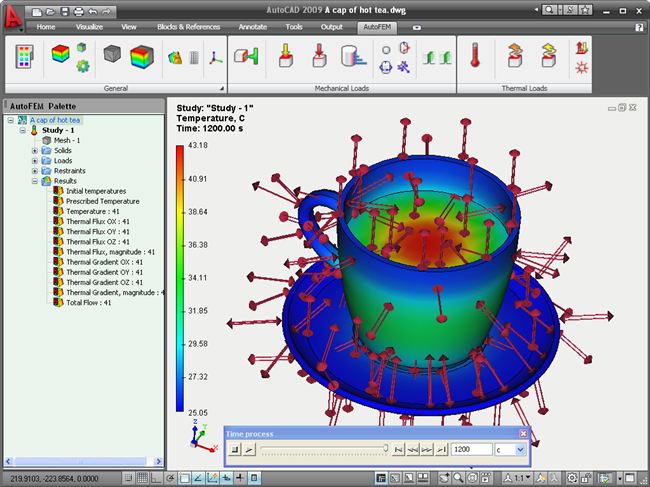
Steady-state thermal analysis is evaluating the thermal equilibrium of a system in which the temperature remains constant over time. In other words, steady-state thermal analysis involves assessing the equilibrium state of a system subject to constant heat loads and environmental conditions.
Example: For many simulations, steady-state thermal analysis can be used to design and evaluate systems, even throughout the final stages of the design process.
es: Análisis térmico de estado estacionario
thermal analysis
Noun
Thermal analysis is a general term defining a technique used to analyze the time and temperature at which physical changes occur when a substance is heated or cooled. Each technique is defined according to the types of physical changes being analyzed.
Example: More advanced temperature profiles have been developed that use an oscillating heating rate (usually sine or square wave) (Temperature Modulated Thermal Analysis) or modifying the rate of heating in response to changes in system properties (Controlled Thermal Analysis per sample).